President William Ruto has called for increased investment in making nutritious food affordable and accessible to millions of people across the globe.
According to Ruto, nearly 2.7 billion people globally cannot afford a healthy diet, with approximately two in every three people in Africa facing the same challenge.

He noted that while food production remains critical in addressing hunger, governments must also ensure that households can access sufficient, safe, affordable and nutritious food.
“Yet hunger is only half the challenge. Nearly 2.7 billion people cannot afford a healthy diet. In Africa, the figure is approximately two in every three,” he said.
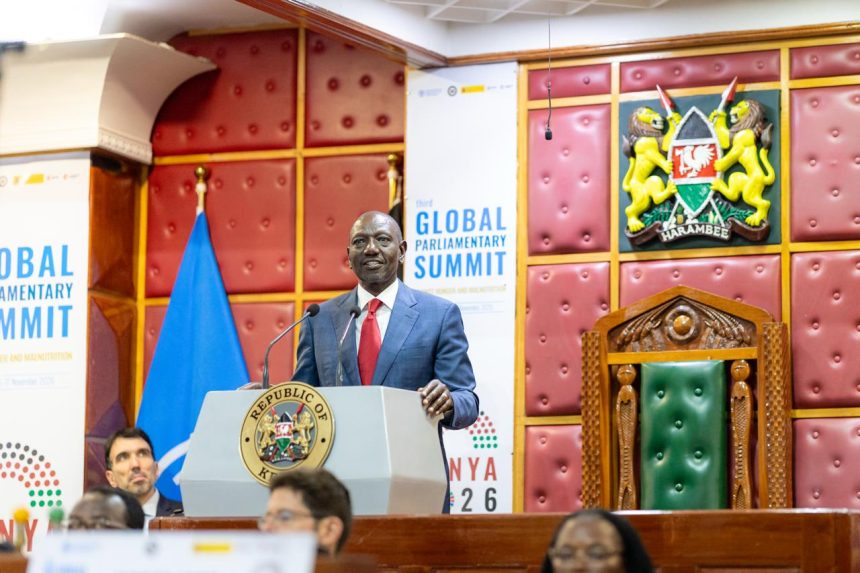
Ruto spoke on Monday during the opening of the Third Global Parliamentary Summit Against Hunger and Malnutrition in Nairobi.
The President noted that food security should not be measured solely by the availability of food, but also by its nutritional value and affordability.
“A child can eat every day and still be malnourished, because a full stomach and a nourished body are not the same thing,” Ruto said.
He urged African countries to strengthen agricultural systems while addressing the economic barriers that prevent families from accessing healthy diets.
To address these gaps, the President said the government has distributed more than 38 million bags of subsidised fertiliser to nearly two million farmers, reducing the price of a 50-kilogramme bag from KSh7,500 to KSh2,000.
Ruto said the interventions had contributed to increased maize production, which rose from 34.3 million bags in 2022 to 71 million bags in 2025.
However, he acknowledged that Kenya was yet to achieve food security, with 2.7 million people facing crisis levels of food insecurity.
He said the government was expanding the school feeding programme, which currently benefits approximately three million learners, with plans to reach 10 million children by 2030 across all 47 counties.
Through home-grown school feeding, the programme will also create a reliable market for smallholder farmers while improving children’s nutrition and school attendance.
Ruto further called on parliamentarians to enact legislation, allocate resources and strengthen oversight to ensure governments deliver on commitments to end hunger and malnutrition.
“If hunger is shaped by public decisions, then ending it requires legislation, budgets and oversight. These are among the fundamental responsibilities of parliaments,” he said.
He challenged African countries to build food systems that not only increase production but also improve nutrition, create employment and generate wealth from agricultural resources.
“We must build an Africa that feeds itself, creates wealth from its agricultural resources and makes its full contribution to feeding the world,” he said.
The summit brings together parliamentarians from across the world to strengthen legislative action, financing and accountability in the fight against hunger and malnutrition.