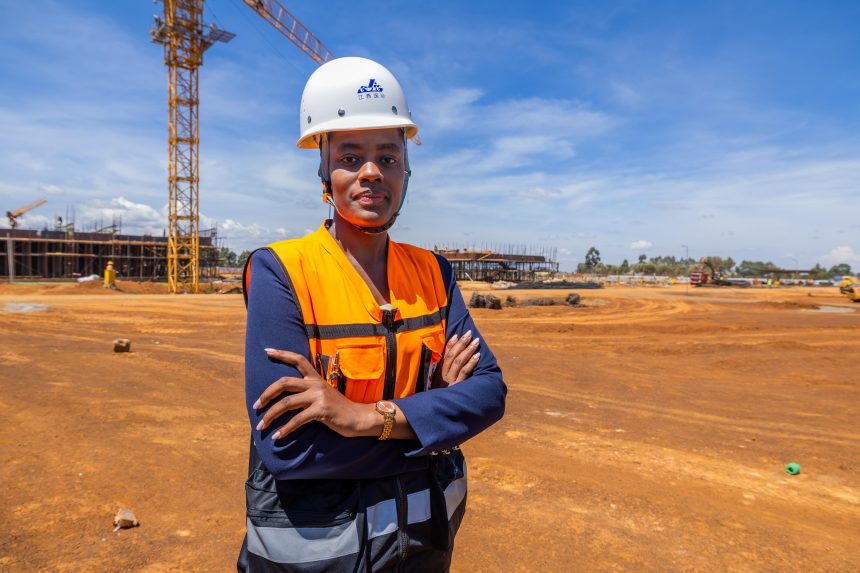
Every day at the construction site of the new Moi Teaching and Referral Hospital in Eldoret, hundreds of workers report for duty, contributing to a project that is gradually taking shape.
Among them is Emily Ndalu Milka, whose job in the Health and Safety Department has become more than a source of income. It has given her new skills, professional exposure and the means to support her family.

As the breadwinner, Milka says her earnings have helped provide food at home, keep her children in school and meet their school fees. She is also able to extend support to neighbours, making her employment an important part of her family’s financial stability.
“I am the breadwinner in my family, and this job helps me support them,” she says. “At least my family has food, my children go to school, and I am able to pay their school fees.”
Her experience reflects the human dimension of the hospital project, where employment is creating immediate opportunities while exposing workers to skills they can carry into future jobs.
Captain Noel Gwada, a civil engineer with the Kenya Defence Forces (KDF) and the project’s Resident Engineer, says the construction site currently has 1,077 workers distributed across different trades, including masonry, electrical installation, carpentry and plumbing.
The workforce is expected to increase as construction progresses, with the project requiring a range of technical and support skills to meet its implementation timelines.
Captain Gwada says the KDF’s role is to oversee project management, ensuring that construction adheres to approved designs and technical specifications, while maintaining quality assurance and close attention to timelines.
The project is being developed as a 4,000-bed ultra-modern multi-speciality hospital, with the first phase providing 2,000 beds. Overall physical progress currently stands at 8.75 per cent, with substructure works at 56.67 per cent and superstructure works at 16 per cent. Completion is anticipated on April 17, 2027.
Beyond the numbers, Milka says the work environment has enabled her to expand her knowledge beyond her initial responsibilities in health and safety. Exposure to both mechanical and civil works has helped her understand different construction processes and identify hazards associated with various activities.
“I have learned how things work in different areas,” she says, explaining that her involvement in mechanical work has broadened her experience.
She is particularly encouraged by the skills other local workers are acquiring. In her view, the project is giving people an opportunity to remain productive, gain practical experience and prepare for employment elsewhere after construction ends.
“I believe that by the time this project ends, we will meet these workers in other places and on other projects, where they will be able to apply their skills and demonstrate their competence,” she says.
Captain Gwada says the social benefits of the development are expected to extend beyond the construction period. Employment opportunities will continue into the hospital’s operational phase, while the services it attracts are expected to stimulate businesses and create further jobs in the surrounding area.
For Milka, the value of the project is already personal. Her income supports her children, while the experience she is gaining is strengthening her professional capabilities.
The hospital is still taking shape, but its impact is being felt in the lives of the people building it. Each working day offers an opportunity to earn, learn and prepare for what comes next.
When construction is complete, the facility will stand as a major healthcare investment. The skills gained by its workforce, however, will travel beyond its walls, potentially opening doors to future employment across the construction and infrastructure sectors.