China has released a comprehensive white paper detailing its vision for reforming global governance, positioning Beijing as a key advocate for multilateralism, development cooperation, and increased representation for developing countries in international affairs.
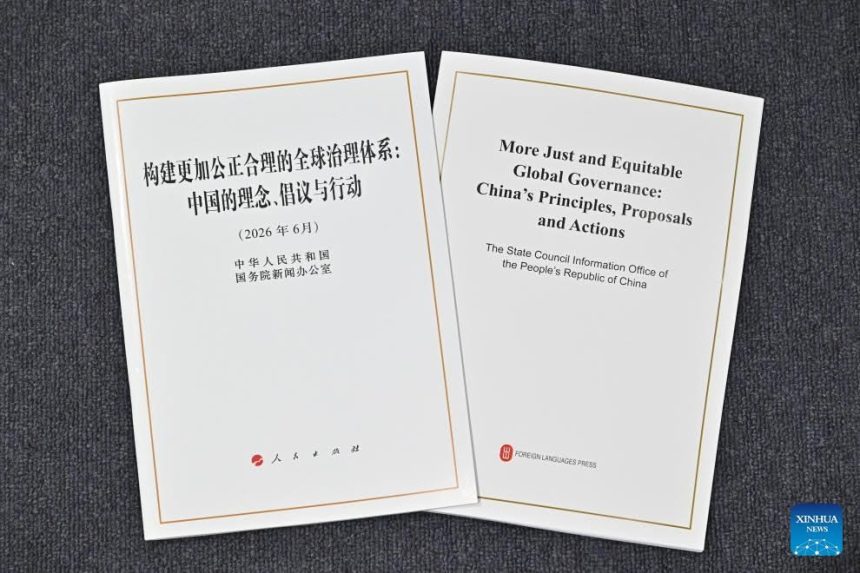
The document, titled “More Just and Equitable Global Governance: China’s Principles, Proposals and Actions,” was issued by the State Council Information Office on Wednesday, and outlines Beijing’s approach to addressing global challenges through what it describes as a fairer and more inclusive international system.

In the white paper, China argues that the world is undergoing profound changes, marked by rising geopolitical tensions, economic uncertainty, and new technological challenges. These shifts, it contends, make the reform of existing global governance structures increasingly necessary.
“China champions the building of a community with a shared future for humanity and takes the lead in practising true multilateralism,” the document states, adding that the country seeks to advance “a more just and equitable global governance system.”
The paper identifies six core areas where China intends to enhance its contributions to global governance.
First, Beijing is keen to promote universal and common security through the implementation of the Global Security Initiative and, here, China reaffirms its commitment to peaceful development, support for the United Nations-led international security framework, and the peaceful settlement of disputes.
The document highlights China’s significant role in global security, noting its status as the second-largest contributor to the UN peacekeeping budget and the largest troop contributor among the permanent members of the UN Security Council. According to the white paper, over 50,000 Chinese peacekeepers have participated in 29 UN peacekeeping missions.
The paper also points to China’s diplomatic engagement in international conflicts, including proposals on the Ukraine crisis, support for a ceasefire in Gaza, mediation efforts between Saudi Arabia and Iran, and reconciliation talks involving Palestinian factions.
“Humanity forms an indivisible community of security,” the white paper declares.
The second area centres on fostering openness, cooperation, and shared development and China reiterates commitment to being a staunch defender of globalisation and free trade, noting that it has become the largest trading partner for over 160 countries and regions and has signed 24 free trade agreements with 31 countries and regions.
The document highlights progress under the Belt and Road Initiative (BRI), which China says now includes cooperation agreements with more than 150 countries and 30 international organisations. China also emphasises the implementation of the Global Development Initiative, which has garnered support from over 130 countries and international organisations.
“China cannot develop in isolation from the rest of the world, nor can the world achieve overall prosperity without China,” the paper states.
The white paper reiterates strong support for the United Nations as the core institution of the international system. It notes that China’s contribution to the UN regular budget has risen from less than one per cent in 2000 to over 20 per cent in 2025, making it the organisation’s second-largest contributor.
The document also highlights China’s participation in G20 cooperation, its support for the reform of international financial institutions, and its plans to host the 2026 APEC Summit under the theme “Building an Asia-Pacific Community to Prosper Together.”
“No matter how the world changes, China will always uphold the international system with the United Nations at its core,” the report affirms.
Support for the Global South
The fourth area focuses on strengthening cooperation among developing countries and increasing the influence of the Global South in global decision-making. The white paper argues that existing governance institutions do not adequately reflect the interests of developing countries and calls for reforms to the United Nations Security Council, the International Monetary Fund, and the World Bank.
China says it will continue supporting mechanisms such as BRICS and the Shanghai Cooperation Organisation while advocating for increased representation for Africa and other developing regions.
“China will always be a member of the Global South, and in the Global South its roots will remain,” the document asserts.
The fifth pillar emphasises cultural exchanges and mutual learning among civilisations. China says it seeks to promote dialogue, respect for diversity, and cooperation among cultures through initiatives such as the Global Civilisation Initiative.
The paper highlights China’s role in securing a United Nations resolution designating June 10 as the International Day for Dialogue Among Civilisations and points to expanded educational, cultural, and youth exchange programmes with countries worldwide.
“China upholds a vision of civilisation characterised by equality, mutual learning, dialogue and inclusiveness,” the document states.
The final area focuses on China’s contribution to international public goods, including climate governance, artificial intelligence, public health, biodiversity protection, and digital governance.
The white paper highlights China’s carbon neutrality goal by 2060, its support for the Paris Climate Agreement, and its efforts to assist developing countries in responding to climate change.
It also outlines proposals for global AI governance, support for World Health Organisation reforms, biodiversity conservation initiatives, and international cooperation on cyberspace governance.
“China has demonstrated the sense of responsibility of a major country that integrates knowledge and action,” the document says.
The white paper ultimately conveys China’s ambition to play a larger role in shaping a global governance system that reflects the interests of all countries, rather than a select few. It argues that international institutions must evolve to effectively address emerging global challenges while providing a greater voice to developing nations.