Kenya and the European Union (EU) have agreed to elevate their longstanding relationship to a comprehensive strategic partnership to deliver greater benefits to the people, President William Ruto has said.
The President noted that the Kenya-EU relationship has yielded immense mutual benefits, but there is still room for deepening cooperation and unlocking greater opportunities for both sides.

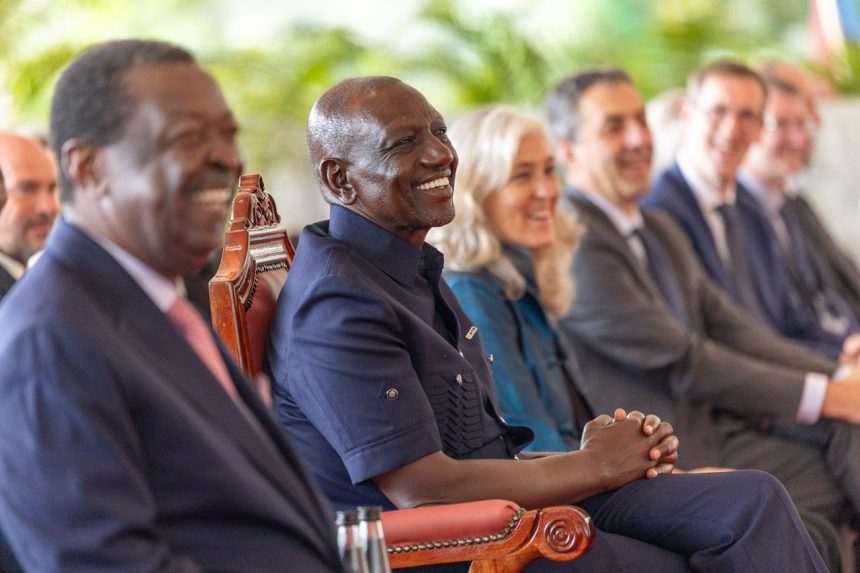
He spoke at State House, Nairobi on Thursday morning when he hosted Heads of EU Delegations to African countries.
The meeting, held as Kenya and the EU marked 50 years of diplomatic relations, focused on translating decades of cooperation into mutual and tangible economic, digital and security gains.
“We agreed to elevate our partnership into a comprehensive strategic partnership anchored in multilateralism, international law, democratic governance and sustainable development,” President Ruto said.
Trade featured prominently in the discussions, with the President noting that the EU remains Kenya’s largest export market, accounting for 21 per cent of the country’s global exports.
He explained that focus should shift to full implementation of the Economic Partnership Agreement (EPA), particularly by addressing barriers that continue to constrain smallholder producers.
These include sanitary and phytosanitary requirements, high freight costs and inadequate cold-chain infrastructure.
“We must now translate the Economic Partnership Agreement into tangible benefits,” he said.
Kenya and the EU, the President pointed out, will explore opportunities to expand European investment in manufacturing, infrastructure, agriculture, energy and healthcare, leveraging the EU’s Global Gateway initiative.
Digital transformation was another key area of discussion, with the partners looking to strengthen cooperation in fibre-optic connectivity, artificial intelligence and digital public services as Kenya positions itself as a regional digital hub.
On peace and security, President Ruto welcomed the EU’s longstanding support for African Union-led missions, including operations in Somalia, as well as a €20 million (Ksh 3 billion) contribution towards strengthening the Kenya Defence Forces.
He challenged both sides to move beyond declarations and translate their commitments into concrete results.
“We must move from dialogue to delivery, from pledges to investments, and from cooperation to measurable outcomes,” he said.
The President added: “Let the next 50 years be defined by a partnership that creates prosperity, strengthens peace and security, expands opportunity and gives our people a greater stake in a more equitable and prosperous world.”
Present were Prime Cabinet Secretary and Cabinet Secretary for Foreign and Diaspora Affairs Musalia Mudavadi, Foreign Affairs Principal Secretary Korir Sing’oei, EU Ambassador to Kenya Andreas Peschke and EU ambassadors based in 44 African countries.
Mudavadi said Africa and the EU ought to work together to define ways of strengthening multilateralism and addressing other emerging global challenges.
Mr Peschke noted that Kenya-EU relations have come a long way, describing the 50-year engagement as meaningful and mutually beneficial.
He said the partnership would be further strengthened to accelerate job creation and trade and investment, enhance peace and security and deepen people-to-people interactions.