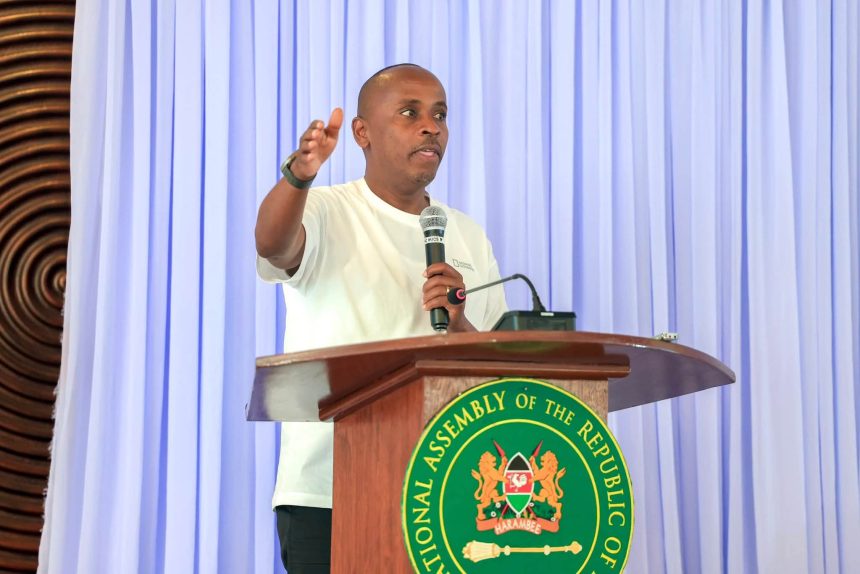
Dagoretti South MP and Chairperson of the Communications, Information and Innovation Committee (CII), John Kiarie, has called for stronger parliamentary oversight as Kenya moves to embrace Artificial Intelligence (AI), saying technological innovation must go hand in hand with accountability, protection of human rights and safeguards for citizens.
Kiarie was speaking when he delivered a key note address during a webinar on “Synchronizing AI Innovations: Legislative Interventions Towards Harnessing AI in Africa”

During the webinar convened by the Centre for Parliamentary Studies and Training (CPST) and moderated by the Director General for Parliamentary Joint Services, Mr. Clement Nyandiere, participants examined how Kenya can harness AI while protecting citizens from its potential risks.
The discussions brought together perspectives from Parliament, government and the technology sector at a time when Kenya is making strides towards AI and other Emerging Technologies Policy.
Kiarie emphasized that Parliament has an important role to play in making sure that AI does not outpace the laws and institutions responsible for protecting Kenyans.
“Parliament must carefully examine how AI is being developed, procured and deployed, particularly where automated systems can influence decisions affecting people’s livelihoods and access to essential services”, the lawmaker noted.
He observed that AI is likely to cause disruptions to employment, education, healthcare, financial services, social protection, security and justice.
The discussions also highlighted the need for Parliament to determine whether existing laws are sufficient to deal with emerging AI-related challenges or whether new legislation and safeguards are required.
Dr Grace Githaiga, CEO and Convenor of the Kenya ICT Action Network (KICTANet), said Kenya should not have to choose between technological innovation and human rights.
She argued that the two can advance together if the country builds a governance framework that encourages innovation while giving citizens, businesses and public institutions confidence that AI systems are being used responsibly.
Ms. Githaiga noted that AI has changed the traditional conversation around privacy and data protection.
“The concern is no longer simply about what personal information is collected and stored. AI systems can analyze large amounts of information, draw conclusions about individuals, create profiles and make or influence decisions based on data whose original purpose may have been very different”, she observed.
This, she said, raises difficult questions about the data used to train AI models, the information systems they infer about individuals and the consequences of automated decision-making.
Concerns that AI could reproduce existing inequalities if systems are trained using historical data that reflects discrimination, exclusion or under-representation, were also raised by participants.
They noted that biases could have serious consequences in areas including recruitment, lending, education, healthcare, insurance and access to public services.
At the same time, the ICT Authority has similarly called for stronger safeguards as government agencies increasingly turn to AI to improve service delivery.
ICT Authority Chief Executive Officer Jessy K Maruti said the government cannot escape responsibility simply because a decision has been assisted or made by an algorithm.
“Government accountability cannot be delegated to a vendor or an algorithm,” Maruti noted.
He identified infrastructure, standards, institutions and accountability as key pillars for responsible AI adoption in government.
Kenya’s digital transformation, the forum noted, must go beyond internet connectivity to include reliable electricity, fibre networks, cloud infrastructure, secure computing capacity, trusted data systems, cybersecurity and adequate digital skills.
Although about 96 per cent of Kenyans are estimated to live within mobile broadband coverage, a significant usage gap remains, demonstrating that access to a network does not automatically translate into meaningful digital inclusion.
Maruti also stressed the importance of human oversight, especially when AI systems are used in decisions that can affect people’s rights, benefits, safety or access to government services.
He called for clear mechanisms through which citizens can challenge decisions, seek human review and obtain appropriate remedies when AI systems make mistakes.
Cybersecurity, he added, must be considered throughout the life of an AI system, from the collection of data and development of the technology to deployment, monitoring and eventual retirement.
The ICT Authority also proposed a risk-based approach to AI regulation, with low-risk applications facing basic safeguards while systems capable of significantly affecting people’s rights or safety would face much stricter requirements.
Maruti avered that high-risk systems could require impact assessments, independent review, external validation, registration, regular audits and clear appeal mechanisms.
Participants also stressed that some uses of AI, particularly those involving unlawful discrimination or manipulation, may need to be prohibited altogether.
With regard to Parliament in particular, the emerging AI landscape presents five major responsibilities: legislation, oversight, representation, resourcing and review.
Kiarie’s Committee is expected to spearhead any necessary policy framework and continually serve as an important platform for examining these issues, including the way government agencies procure AI technologies and whether taxpayers are receiving value while citizens’ rights are protected.
The Committee is also expected to ensure that communities affected by AI have an opportunity to participate in shaping the rules governing the technology, while regulators and oversight institutions receive the technical and financial resources necessary to do their work.
The proposed government roadmap includes taking stock of existing AI systems and pilots, introducing interim rules for AI use and procurement, identifying accountable officers and developing risk classifications and impact assessments.
High-risk systems could subsequently be subjected to certification, interoperability testing and publication of performance and audit findings.
The message emerging from the CPST meeting was clear: Kenya should not slow down innovation, but neither should it allow technology to move ahead without safeguards.
As the country positions itself as a regional technology hub, the real measure of success will be on whether AI can improve lives and public services without sacrificing the values that protect citizens.
In his concluding remarks, Kiarie noted that the challenge facing Kenya is not how quickly the country can adopt AI, but how responsibly it can do so while protecting human dignity, equality, privacy, freedom of expression, access to information and accountability.