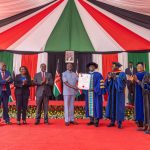

The Nairobi Rivers Regeneration Project on Friday marked National Mazingira (Environment) Day 2025 with a field visit showcasing progress under the Nairobi River Regeneration Project (NRRP). The KSh 50 billion flagship initiative seeks to restore and transform the Nairobi, Mathare, and Ngong rivers into clean, vibrant, and resilient urban ecosystems that can once again support life, livelihoods, and public health.
The project, launched in March 2025 by His Excellency President William Ruto, represents one of Kenya’s most ambitious environmental and urban renewal efforts. The program is designed to reclaim the river corridor as the ecological and social spine of the city. It brings together multiple government agencies, the Nairobi City County Government, development partners, and communities living along the river to achieve one shared goal: a cleaner, greener, and more inclusive Nairobi by 2027.

For decades, the Nairobi River system has mirrored the challenges of rapid urbanization—uncontrolled dumping of solid waste, raw sewage discharge, encroachment of informal settlements, industrial pollution, and unplanned construction on riparian reserves. Up to 60 percent of wastewater entering the rivers has historically been untreated, while weak planning enforcement and inadequate waste systems have turned the rivers into open sewers. These conditions have worsened flooding, contributed to disease outbreaks, and degraded the environment, especially in densely populated areas such as Korogocho, Kamukunji, and Lucky Summer.
It was against this backdrop that the Nairobi River Regeneration Project was established. The NRRP adopts a holistic approach to renewal, combining infrastructure upgrades, social inclusion, and environmental restoration. Rather than offering short-term cleanups, it aims to tackle the root causes of pollution and urban decay through long-term, evidence-based interventions that integrate modern sanitation, green infrastructure, and participatory urban planning.
According to Lt. Col. Kahigu Njoroge, the Project Manager of the NRRP, the initiative represents a decisive shift in how the city manages its environment and growth.
“The Nairobi River Regeneration Project is a bold step to reclaim the city’s river spine by restoring riparian land, removing solid waste, and improving sanitation,” said Lt. Col. Njoroge. “We are rebuilding Nairobi from its rivers outward—creating green spaces, safer neighborhoods, and stronger communities. This is not just about cleaning a river; it is about restoring the city’s dignity and resilience.”
The Mazingira Day media tour took journalists through key restoration sites, including Kamukunji Grounds, City Cotton, Lucky Summer, and the Dandora dumpsite. At Dandora, where nearly 300 metres of the river have been blocked and submerged by accumulated waste, the NRRP team demonstrated ongoing efforts to clear the obstruction, stabilize the riverbanks, and establish modern waste management systems. The site, long known as one of Nairobi’s most polluted points, is now the focus of major interventions aimed at restoring natural river flow and preventing future contamination.
Lt. Col. Njoroge emphasized that the Dandora section represents both the scale of the challenge and the opportunity for transformation. “The Dandora stretch shows what we are up against, but it also shows what is possible,” he said. “Clearing this section is about restoring life to a river that has sustained this city for generations. With strict enforcement, improved waste systems, and community partnerships, we are working towards a Nairobi where pollution is no longer a way of life.”
The project’s design is anchored on five strategic pillars: flood control and drainage systems, sanitation and sewer infrastructure, urban transport and accessibility, catchment restoration, and urban landscaping. Its key components include the construction of a 60-kilometre trunk sewer line to prevent untreated waste from entering the river, the establishment of a new decentralized wastewater treatment plant in Kariobangi, flood control and stormwater management works along the river corridor, and the decontamination of the Dandora dumpsite.
In addition, the project will deliver 10,000 social and affordable housing units integrated with modern markets, green corridors, and non-motorized transport routes such as walkways and cycling paths. It will also expand tree cover and create recreational parks and public spaces to enhance the city’s liveability and environmental balance. Additionally, a 60 kilometers new trunk sewer city system is being constructed along the river from Ondiri swamp in Kikuyu to Ruai, to address the current sewer system over-burdened by a rapidly growing population in the city.
Maureen Njeri, County Executive Commissioner for Green Nairobi, underscored the Nairobi City County Government’s commitment to ensuring that communities remain central to the regeneration process.
“True regeneration begins with the people,” said Ms. Njeri. “The communities living along the Nairobi River are not passive beneficiaries—they are partners in this transformation. Their efforts in greening, waste management, and advocacy are shaping how we design housing, sanitation, and urban spaces. Together, we are rebuilding a Nairobi that works for both people and nature.”
At the community level, the project is already having a social impact. Josephat Karomi, Chairperson of the Kamukunji Nairobi River Community, noted that regeneration efforts have helped empower young people and foster safer neighborhoods.
“The Kamukunji project is progressing well and has given our youth new purpose,” he said. “Through the Nairobi River Regeneration Project, young people are now involved in tree planting, riverbank clean-ups, and sports instead of crime. A new football pitch with modern amenities is being built, showing that this project is transforming lives, not just landscapes.”
The Nairobi River corridor has been designated as a Special Planning Area (SPA) under the Physical and Land Use Planning Act, 2019. This legal status temporarily halts new developments within a 60-metre buffer zone—30 metres of riparian reserve and 30 metres of adjacent land—to allow for a participatory planning process. Over the next two years, this process will result in an Integrated Development Plan that balances ecological recovery, infrastructure renewal, and social justice.
Pollution from the Nairobi River currently affects more than 2.5 million residents and threatens critical water resources downstream, including Thwake Dam. By combining engineering, governance, and community action, the NRRP seeks to change that trajectory. It will reduce exposure to contaminated water, create employment in green construction and waste management, improve sanitation, and promote safer and more organized urban development.
Lt. Col. Njoroge summarized the broader vision of the project: “The Nairobi River Regeneration Project is more than an infrastructure plan—it is a blueprint for fairness, health, and hope. Every restored metre of riverbank brings us closer to a Nairobi where clean water, safe housing, and green public spaces are a shared reality for all.”