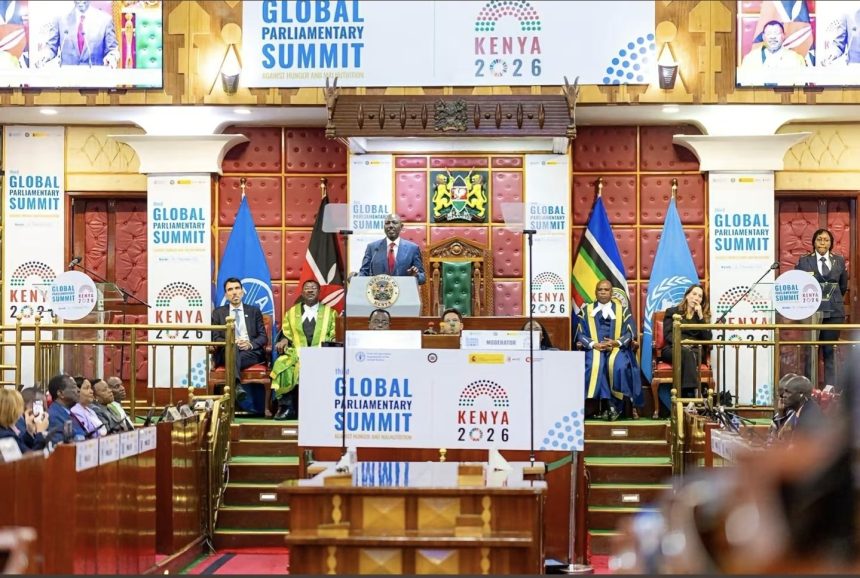
President William Ruto has called on parliaments across the world to translate commitments into tangible results in the fight against global hunger and malnutrition.
Speaking during the opening of the Third Global Parliamentary Summit Against Hunger and Malnutrition at Parliament Buildings in Nairobi on Monday, the President said legislatures have the power to turn political promises into practical interventions through legislation, budgetary allocations and oversight.

He called on parliaments to enact legislation that gives practical effect to the right to adequate food and nutrition.
“Use your legislative authority, budgetary powers and parliamentary diplomacy to advance fairer financing, stronger regional integration, greater climate investment and a global economic order that rewards productive transformation rather than perpetuating dependency,” he said.
Through their budgetary powers, President Ruto urged legislators to safeguard investments in agricultural productivity, irrigation, research, nutrition and social protection.
“Create frameworks that crowd-in responsible private capital and ensure that food security is treated not simply as an annual expenditure, but as a long-term investment in national prosperity,” he said.
The President further challenged parliaments to strengthen oversight mechanisms to ensure public resources are prudently utilised to increase agricultural production, improve household incomes and enhance nutrition outcomes.
Citing Kenya’s agricultural reforms over the past four years, the President said maize production had increased from 34.3 million bags in 2022 to 71 million bags in 2025 while the country had emerged as Africa’s leading milk producer.
He attributed these gains to policy reforms and sustained budgetary support from Parliament, noting that the legislature had played a critical role in advancing the country’s agricultural transformation agenda.
Despite the progress, however, the President acknowledged that Kenya remains far from achieving food security, with malnutrition estimated to cost the economy 6.9 per cent of Gross Domestic Product (GDP).
“Recent assessments have identified 2.7 million Kenyans facing crisis levels of food insecurity, with hundreds of thousands of children and pregnant and breastfeeding women requiring nutritional support,” he said.
To address these challenges, President Ruto said the Government, through the National Infrastructure Fund, is pursuing an ambitious water infrastructure programme involving the construction of at least 50 mega dams, 200 medium and small dams, and thousands of micro dams.
This initiative is expected to support water harvesting and storage while bringing an additional 2.5 million acres under irrigation within the next five to seven years.
“This investment will transform our arid and semi-arid regions into productive centres of agriculture, agro-processing and employment, making our harvests more predictable, strengthening climate resilience and supporting our ambition to become a net exporter of agricultural products,” he said.
On the continental front, President Ruto reiterated the need to reform the international financial architecture to enable African countries to mobilise affordable financing to tackle hunger, strengthen agricultural production and respond to climate change.
“Our countries borrow at substantially higher interest rates than advanced economies, face disproportionate debt-servicing burdens and struggle to access affordable, long-term capital,” he said.
The President also urged African parliaments to enact legislation that mobilises domestic resources, strengthens food production and provides sustainable solutions to food insecurity in their respective countries.
He challenged delegates attending the Nairobi Summit to move beyond declarations and commitments and deliver measurable improvements in the lives of families and communities affected by hunger and malnutrition across the world.
“They will not read the declarations you adopt or follow the proceedings of your committees. But they will know whether your decisions will have made food more affordable, their children better nourished and their future more secure,” he said.
Present at the summit were Prime Cabinet Secretary Musalia Mudavadi, National Assembly Speaker Moses Wetang’ula, Senate Speaker Amason Kingi, Cabinet Secretaries Aden Duale (Health) and Rebecca Miano (Tourism).
Others were UN agency Food and Agriculture Organisation Deputy Director-General Maurizio Martina and UN Secretary-General Special Representative for Children and Armed Conflict Vanessa Frazier, among other dignitaries.