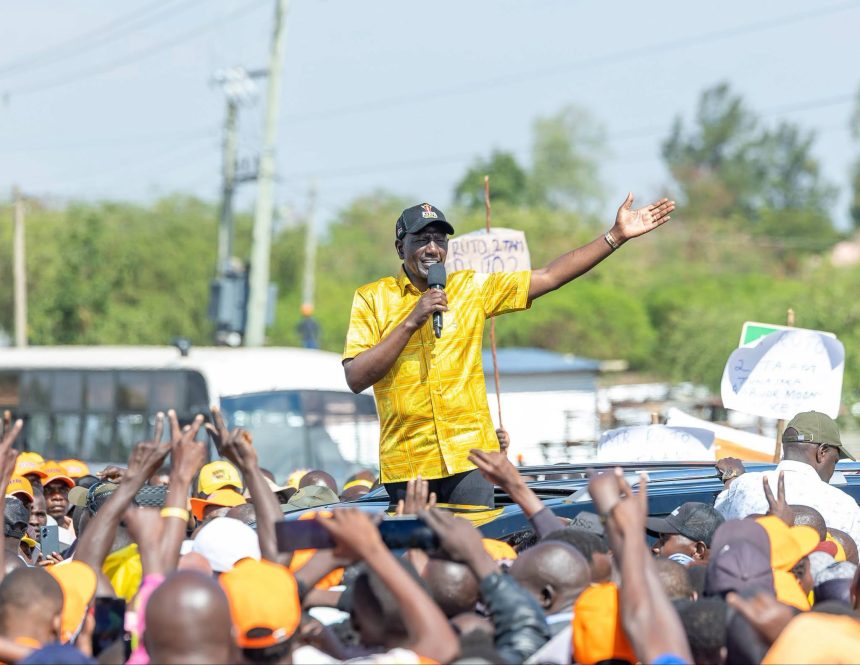
President William Ruto has mounted a strong defence of his administration’s Affordable Housing Programme, challenging politicians advocating for its abolition to explain what they would offer the millions of Kenyans seeking homes, employment, and improved living conditions.
Speaking during an interview with KBC’s Mayienga FM while touring Nyanza, President Ruto stated that affordable housing was not merely a construction initiative but a comprehensive economic and social intervention designed to transform the lives of ordinary Kenyans.

“If there is one thing that will forever change the destiny of our nation, it is affordable housing,” Ruto declared.
The President dismissed calls to scrap the programme, questioning what critics would propose as an alternative, particularly for the thousands of individuals he stated are currently employed within the affordable housing sector.
“I want to ask those of you who are saying they are going to abolish this housing programme, what is their alternative plan for the 1.1 million citizens who today work in the affordable housing programme?” he enquired.
Ruto explained that the programme had created an industry extending beyond construction, generating employment and supporting businesses involved in the supply of materials and related services.
He also defended the programme on the grounds of home ownership, noting that Kenyans were registering for housing projects because they desired to transition from being tenants to owning their homes.
“Citizens themselves, they register themselves and went and built their own houses. Because they know that once the houses are built, they will come there not as tenants but as owners,” he affirmed.
The President cited projects targeting residents of informal settlements as evidence of the programme’s potential to restore dignity to Kenyans living in challenging circumstances.
Recalling an occasion when he handed over housing keys to residents from Mukuru informal settlement in Nairobi, Ruto said the emotional response of beneficiaries illustrated the profound meaning of home ownership for families who had endured poor living conditions.
“When I went to hand over keys to some of the people who came from Mukuru, you could see tears in their eyes. Somebody who has never seen a toilet in their house. People who pay to use a toilet,” he recounted.
Ruto emphasised that affordable housing should also be considered in terms of providing basic services and upholding human dignity, particularly for families residing in areas without reliable access to water, electricity, roads, or sanitation.
“Just imagine somebody who lives in a house that has no toilet, has no water, has no electricity, has no road, but you want to stop the only plan that can give them a chance to own a home,” he stated.
Ruto noted that the Housing Fund was also being utilised to finance modern markets for small traders who have traditionally operated in difficult conditions.
He explained that the programme aimed to provide traders, including ‘mama mbogas’, with access to markets equipped with facilities such as water and sanitation, while simultaneously creating new commercial spaces. Ruto cited plans to construct a Ksh 1.5 billion market in Kisumu and 20 markets across the county, noting that three were already completed.
The President further stated that the Housing Fund was being used to construct hostels for students in universities and TVET institutions, linking the programme to the broader challenge of providing decent student accommodation. He challenged those seeking to abolish the programme to explain whether they wanted students to continue living in what he described as indecent settlements.
“Before you talk about abolishing housing, go tell our students in university that you want them to continue living in settlements that are indecent,” Ruto urged.
His defence comes amidst ongoing political debate over the housing levy and the government’s affordable housing agenda, with critics questioning its cost and implementation.
Ruto, however, argued that abandoning the programme would not only jeopardise the government’s housing ambitions but also undermine jobs, businesses, markets, and the opportunity for low-income Kenyans to become homeowners.