The Independent Electoral and Boundaries Commission (IEBC) has today confirmed that it enrolled 2.6 million Kenyans onto the voters’ roll during the continuous voter registration exercise, which took place from 29 September 2025 to 28 April 2026. The commission described the initiative as a complete success.
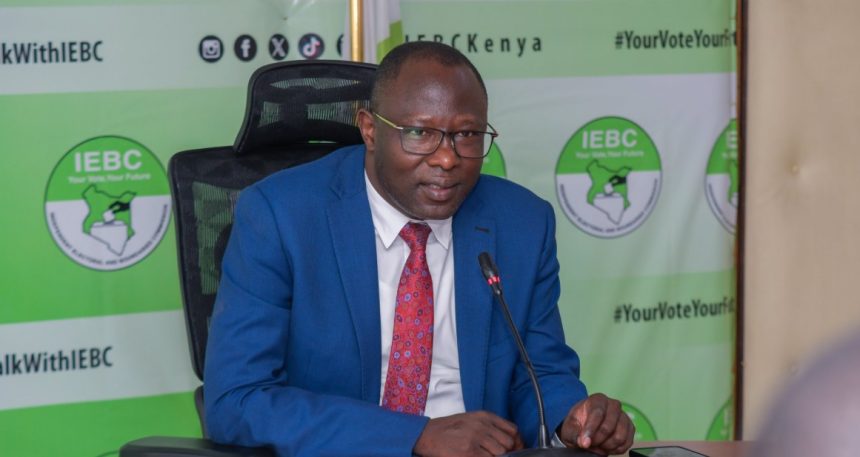
IEBC Chairperson Erastus Ethekon stated that the figure represents a significant achievement in the country’s voter registration efforts, noting that the commission has exceeded expectations in both output and efficiency compared to previous electoral cycles.

He explained that the total comprised 267,249 voters registered at constituency offices during the continuous voter registration phase, while an additional 2,345,476 were registered during the enhanced mass registration exercise conducted over a 30-day period.
According to Ethekon, the daily and weekly registration performance showed an upward trend, with the commission recording over 500,000 new registrations per week during the peak phase of the exercise.
He contrasted these results with earlier registration cycles, citing the 2016 and 2021 exercises, where lower numbers were recorded against set targets.
“In 2016, when the electoral management body conducted mass voter registration in phase 1, the previous team managed to capture around 1.4 million voters against the target of four million within the 30 days. We had a target of 2.5 million within 30 days, and we managed to achieve that target,” he said.
“Over a similar period, also in 2021, the numbers were also lower. And therefore, taken in totality, this comparative analysis highlights a clear institutional progression in the design and execution of voter registration strategies in Kenya,” the chairperson explained.
He noted that the analysis points to a clear advancement in the development and implementation of voter registration strategies.
The IEBC Chair attributed the improved performance to operational reforms, including the adoption of an open kit strategy that allowed eligible voters to register from multiple locations without being confined to their constituencies of origin.
He stated that this approach eliminated long-standing geographical barriers that previously limited participation, particularly for voters living and working away from their home areas.
The commission also expanded registration points beyond ward offices to include institutions of higher learning, such as universities and technical and vocational education and training (TVET) centres, as well as other training institutions.
For the first time, the IEBC integrated voter registration services within selected government service points, broadening access and convenience for citizens.
Ethekon stated that these reforms significantly strengthened participation, describing the exercise as evidence of improved institutional capacity and strategic delivery in managing large-scale electoral processes.