President William Ruto has directed a further Ksh 10 reduction in the price of diesel for the June–July 2026 pricing cycle, as part of ongoing government interventions to cushion Kenyans from the global fuel crisis.
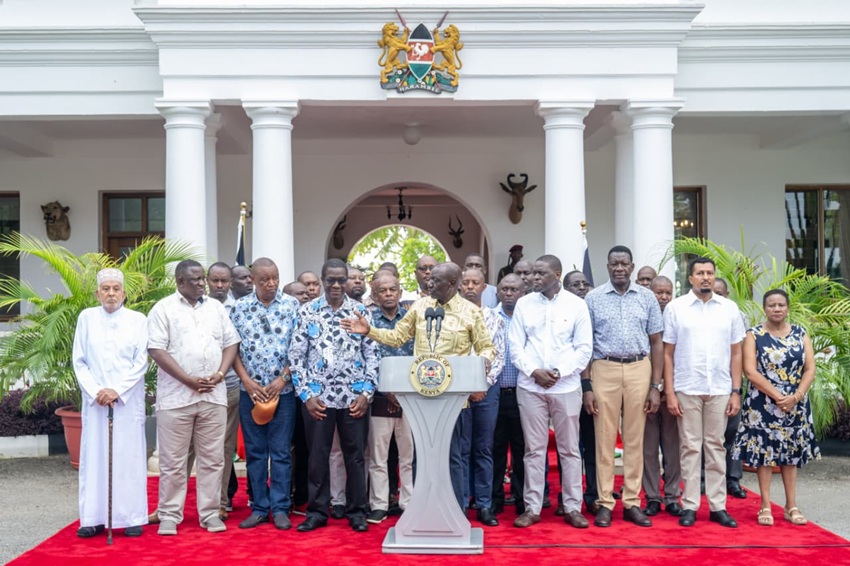
Speaking at State House, Mombasa Friday, following a meeting with transport sector stakeholders, the President detailed the government’s extensive fuel price stabilisation efforts over the past two pricing cycles.

“The Government has used the Petroleum Development Fund to stabilise fuel prices,” President Ruto stated. He revealed that in the April–May 2026 cycle, the government utilised Ksh 6.04 B for fuel stabilisation and forewent Ksh 6.41 B in VAT revenue. “In total, the Government spent Ksh 12.45 B on stabilisation during that cycle,” he said.
As a result of these interventions, “Super Petrol prices were reduced by Ksh 19.67 per litre, Diesel by Ksh 40.25 per litre, and Kerosene by Ksh 115.03 per litre.” He added.
In the current May–June 2026 pricing cycle, the President explained that “the Government utilised another Ksh 7.7B for stabilisation and forewent Ksh 8.02B in VAT revenue.” He added, “In total, during the current cycle the Government has spent Ksh 15.72B on stabilisation.”
Without government action, the President warned, “Super Petrol would today have retailed at Ksh 230.12 per litre instead of Ksh 214.25; Diesel would have retailed at KSh 277.75 instead of Ksh 232.86; and Kerosene would have retailed at KSh 270.00 instead of Ksh 191.38.”
Across both cycles, “the Government has committed a total of Ksh 28.19B in fuel price support through direct stabilisation measures and tax relief interventions.”
President Ruto further directed that the cost of diesel be further reduced by Ksh 10 in the June–July cycle to help stabilise pump prices and provide additional relief to consumers.
He attributed the crisis to global factors, noting that ” Since the conflict involving Iran escalated on 28th February 2026, the Strait of Hormuz, one of the world’s most important oil supply routes, through which nearly one-fifth of global oil passes every day, has experienced major disruption. This has created one of the largest global oil supply shocks in modern history.” This has led to “global fuel prices rising sharply, with prices increasing by 54.4 per cent for Super Petrol, 118.5 per cent for Diesel, and 126.4 percent for Kerosene.”
The President assured Kenyans that “there is no fuel shortage in Kenya,” crediting the Government-to-Government fuel framework introduced in 2023. “Through the Government-to-Government framework, under which international oil suppliers are contractually obligated to maintain consistent supply, the Government is taking all necessary measures to ensure continued, uninterrupted supply and stability in the market.”