China’s 77-year journey has been marked by profound changes across industry, technology, public services, and living standards, evolving from a nation once defined by widespread poverty into a leading global economic and manufacturing power.
This transformation offers insight into how sustained development efforts can reshape a nation’s economic fortunes and global standing.

Today, China stands as the world’s second-largest economy, a significant force in global trade, and a growing hub of technological innovation. Its development narrative also encompasses efforts to eradicate absolute poverty, broaden access to education and healthcare, and tackle environmental challenges in tandem with economic growth.
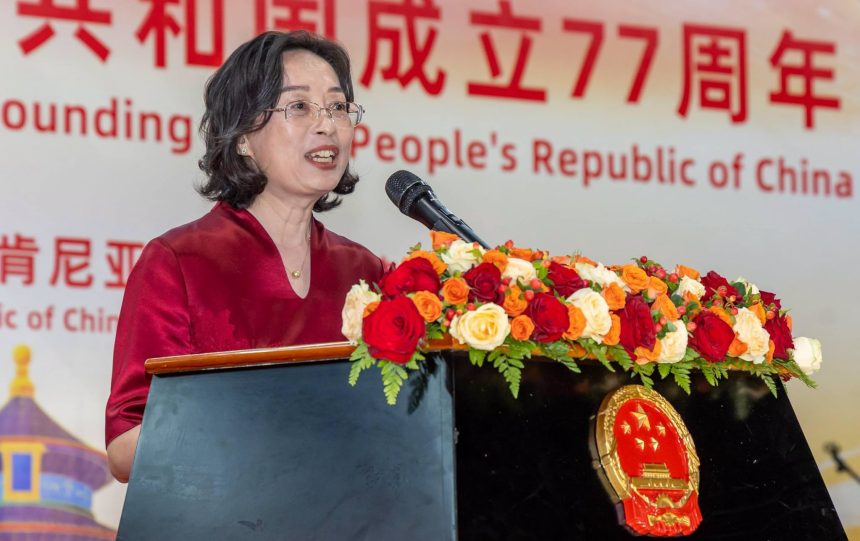
Speaking at a reception in Nairobi to commemorate the 77th anniversary of the founding of the People’s Republic of China, Chinese Ambassador to Kenya Guo Haiyan reflected on the country’s progress since 1949. She described its transformation as a journey from economic hardship to greater prosperity and national strength.
“Looking back at history, the Chinese nation has journeyed from the brink of extinction to great rejuvenation,” she said.
Ambassador Guo noted that China’s per capita gross domestic product had increased from 36 US dollars to approximately 13,900 dollars, positioning the country as a major contributor to global economic growth.
She attributed this progress to sustained national development, self-reliance, and the pursuit of modernisation, emphasising that these efforts had enhanced people’s lives and solidified China’s position in the global economy.
Guo said the scale of China’s transformation would have been difficult for the country’s founders to imagine when the People’s Republic was established in 1949.
“They may have envisioned but could hardly have imagined that the absolute poverty that had plagued the Chinese nation for thousands of years would be eradicated at its root,” she said. She highlighted the expansion of education, social security, and healthcare systems across the country as among the nation’s most significant achievements.
She added that the founders could also hardly have imagined that a predominantly agricultural country, where even tractors could not be manufactured, would become the world’s largest manufacturing country, the largest trader in goods, and the largest holder of invention patents.
Guo drew attention to the country’s strength in global production and trade, as well as developments in new-energy vehicles and robotics. She cited China’s advances in new-energy vehicles and humanoid robots as examples of its technological transformation, saying Chinese new-energy vehicles now account for 60 per cent of global sales, while humanoid robots account for 97 per cent of global shipments.
“The Chinese nation has achieved a great leap from standing up to growing prosperous and to becoming strong,” Guo declared.
She credited the leadership of the Communist Party of China and the pursuit of Chinese-style modernisation, which she stated prioritises people’s aspirations for a better life at the core of development.
Beyond economic growth, Guo underscored environmental initiatives. She said forest coverage had risen to 25 per cent of the country’s total land area and that China had contributed about one quarter of the world’s newly added green areas. She also highlighted efforts to combat desertification and improve air quality, citing the green belt developed around the Taklamakan Desert and the recovery of endangered species as examples of China’s commitment to addressing environmental challenges.
The transformation, she said, had extended beyond the economy to culture, with China’s traditional heritage gaining renewed global appeal. Guo cited the growing popularity of “Travel to China” and “Chinamaxxing” among young people worldwide as signs of this cultural reach.
The ambassador also placed China’s development within the context of its international partnerships, highlighting 70 years of diplomatic relations between China and African countries. She explained that this relationship had evolved from a history of solidarity rooted in independence and self-determination into broader cooperation across trade, investment, and modernisation.
Turning to Sino-Kenya relations, Guo affirmed that Nairobi’s partnership with Beijing continues to offer opportunities in trade, infrastructure, agriculture, energy, education, and technology.
She pointed to increased Kenyan exports to China following the implementation of zero-tariff measures in May. According to Guo, exports of avocado oil had surged by 700 per cent, aquatic products by 350 per cent, while coffee exports had almost doubled by the end of August.
Guo stated that China is prepared to deepen economic cooperation with Kenya and strengthen exchanges on development strategies, science and technology, and skills development.
“China stands ready to strengthen exchanges with Kenya on development philosophies and align our development strategies,” she said, adding that China will work hand in hand with Kenya on their respective paths toward modernisation.
She further noted that China is currently keen to expand cooperation with countries pursuing their own development goals.
“China stands ready to deepen cooperation with Kenya in infrastructure development, energy, agriculture, education, youth affairs, science and technology and other fields, continuously elevating mutually beneficial cooperation to new heights,” she stated.
She said China will use its position to particularly champion the common interests of nations in the Global South.