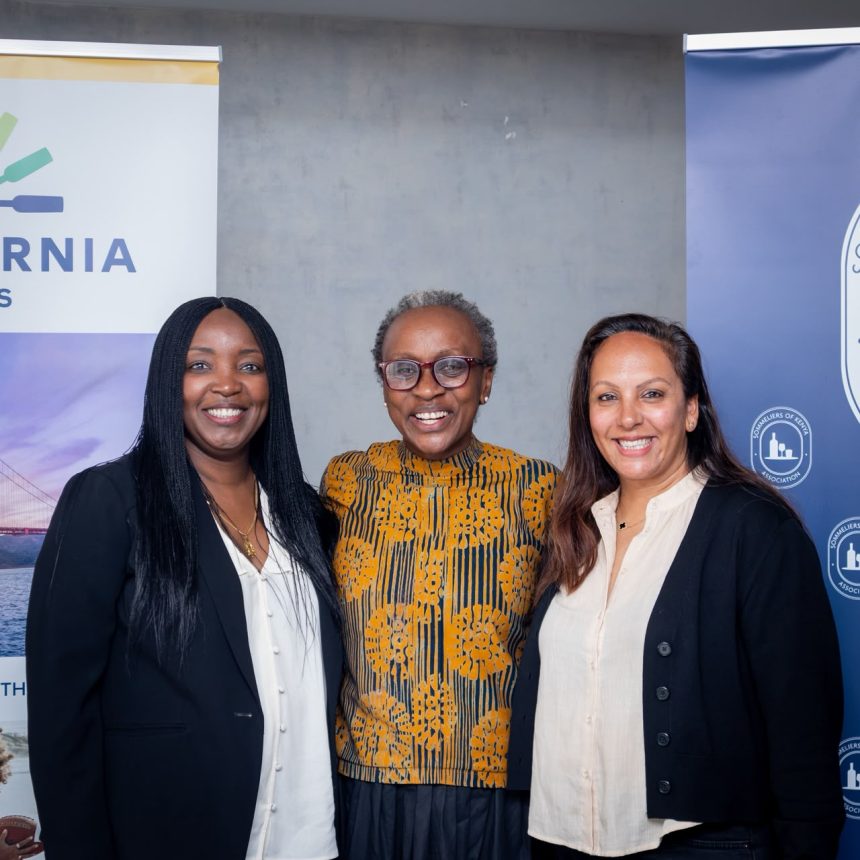
Kenya is set to make history in October when it appears for the first time at the Association de la Sommellerie Internationale (ASI) Best Sommelier of the World Contest in Lisbon, Portugal, and the country’s flag-bearer will be Soraiya Ladak, crowned ASI Kenya’s Best Sommelier 2026.
The milestone, announced this week, positions Kenya alongside Morocco, Zimbabwe, South Africa and Mauritius as the only African nations with representation in the ASI, the governing body widely regarded as setting the highest standard in the global sommelier profession.

Held once every three years, the Best Sommelier of the World Contest draws national champions to compete across advanced wine theory, blind tasting, food-and-wine pairing and hospitality service, a discipline as much about precision and memory as it is about palate.
Speaking at the recent California Wines Masterclass in Nairobi, Ladak described the selection as a milestone for the wider industry rather than a personal one.
She called it a chance for Kenya’s hospitality sector to demonstrate the talent and professionalism it has built, noting that the country has earned its place at the global table.
Ladak’s path to the title has been years in the making.
She is Managing Director of The Wine Shop Kenya, a family-run boutique wine business in Nairobi’s Loresho neighbourhood that has grown into one of East Africa’s leading wine distribution houses, representing wineries from across the globe alongside curated tastings and food pairings.
Her technical grounding includes the WSET Level 3 Award in Wines, along with professional coursework through the Court of Master Sommeliers and the ASI itself, credentials that reflect a sommelier profession increasingly defined by structured, internationally benchmarked training rather than informal expertise.
Ladak’s competitive record extends beyond the ASI title.
She has represented Kenya multiple times at the World Blind Tasting Championship, dubbed the “Wine Olympics”, as part of Team Wine Kenya, an all-female squad whose 2024 outing saw Kenya outperform established wine nations including England.
She is also the current champion of the Best of Kenya Sommelier Contest and, at the seventh edition of The Wine Fair Nairobi in early August, hosted a Blind Wine Tasting Masterclass under the Sommeliers of Kenya Association (SOKA) banner that drew more than 40 industry professionals, importers and enthusiasts.
Neil Van Velden, Regional Manager for Africa at the California Wines Institute, pointed to the collaboration between Master Sommelier Adam Pawlowski and SOKA as evidence of the association’s expanding influence, describing SOKA, established less than a year ago, as still young but already central to developing Kenya’s wine culture.
SOKA President Wanjiru Mureithi framed Ladak’s achievement as validation of a broader strategy: building structured pathways for Kenyan sommeliers to gain international certification, education and competition exposure.
As Kenya’s official ASI affiliate, SOKA now links local professionals to global standards through technical training, mentorship, national competitions and international partnerships, infrastructure that barely existed in the local wine trade a decade ago.
Ladak’s crowning arrives at a moment when Kenya’s hospitality and tourism sector is posting some of its strongest numbers in years, and when wine, once a niche import category, is becoming a more visible part of the country’s hospitality proposition.
Kenya’s tourism sector generated an estimated Ksh. 500 billion in 2025, according to the Kenya Tourism Sector Performance Report, on the back of an estimated 7.9 million tourists comprising 2.7 million international visitors and 5.2 million domestic travellers.
International arrivals grew roughly 9% year-on-year, more than double the global average growth rate of about 4%, driven by improved connectivity, streamlined visa processes and sustained destination marketing under the Magical Kenya brand.
Separately, the World Travel & Tourism Council projected the sector would contribute a record Ksh. 1.2 trillion to the economy in 2025, 24% above 2019 levels and equivalent to more than 7% of national GDP, while supporting an estimated 1.7 million jobs, or over 8% of total national employment.
That growth is reshaping what visitors, and increasingly, affluent domestic consumers, expect from Kenyan hotels, restaurants and lodges.
Curated wine experiences, professional pairing services and wine education are becoming differentiators in a competitive regional hospitality market, according to the press release announcing Ladak’s selection, which put Kenya’s local wine market at approximately $286 million, with imports of premium wines continuing to grow alongside rising demand for professional service and wine knowledge.
The sommelier profession sits at the centre of that shift.
As Kenyan hotels and restaurants compete for high-value leisure and business travellers, the ability to offer credible, internationally certified wine expertise has become a marker of service quality rather than a luxury add-on.
Industry commentary on Kenya’s emerging wine sector points to the same dynamic: hotels, lodges and restaurants are increasingly showcasing wine, including a small but growing base of Kenyan-grown wine from Rift Valley regions such as Naivasha, Elementaita and Nakuru, as part of the broader guest experience, turning what was once purely an import category into a talking point for agri-tourism and hospitality storytelling alike.
Bodies such as SOKA are the institutional backbone of this shift.
By formalising certification pathways, technical masterclasses and competition exposure, SOKA and its ASI affiliation are professionalising a discipline that, until recently, had few structured entry points in Kenya.
That, in turn, feeds directly into hospitality sector competitiveness: better-trained sommeliers mean stronger guest experiences, higher average spend on food-and-beverage service, and a more credible platform from which Kenyan hospitality brands can market themselves internationally.
The ASI Best Sommelier of the World Contest will be held in Lisbon from October 11 to 17, 2026, bringing together national champions from dozens of countries.
For Kenya, simply fielding a competitor is historic.
For Ladak, the contest is both a personal test and, as she put it, an opportunity to showcase the talent, professionalism and passion that define Kenya’s hospitality industry on a stage the country has never before occupied.