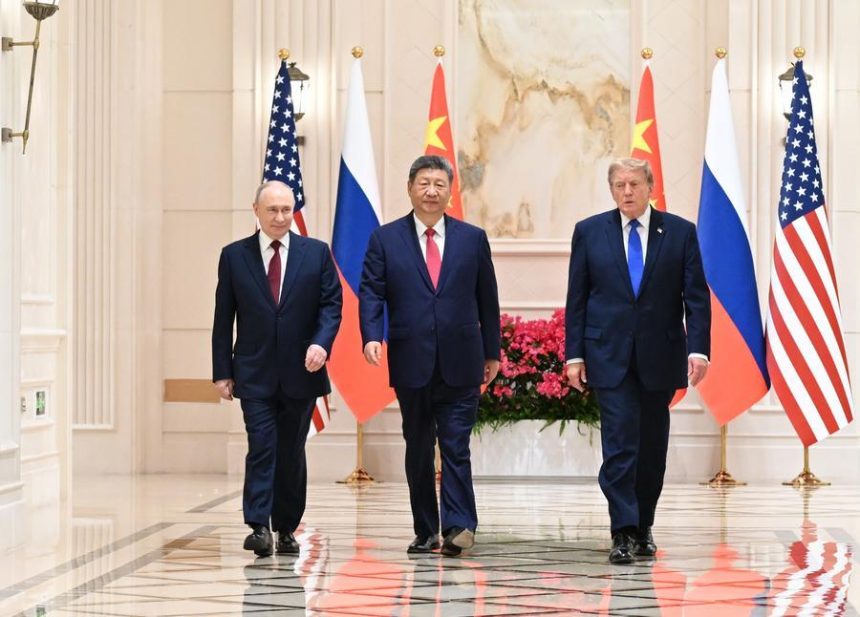
China, the United States, and Russia have announced a joint commitment to strengthen international security and strategic stability. This commitment will be pursued through cooperation on United Nations reform, energy security, nuclear risk reduction, and respect for state sovereignty.
The commitments are detailed in a joint declaration issued Thursday, following a trilateral summit in Shenzhen, Guangdong Province, southern China, between Chinese President Xi Jinping, Russian President Vladimir Putin, and US President Donald Trump.

The declaration outlines four key areas where the three permanent members of the United Nations Security Council intend to contribute to international peace and address emerging global challenges.
On global governance, the three nations pledged to pursue reforms aimed at making the United Nations more responsive to international challenges and strengthening its capacity to fulfill its foundational mandate of maintaining international peace and security.
The commitment places the UN’s effectiveness at the core of their proposed cooperation, acknowledging its vital role in addressing conflicts and other threats to global stability.
On energy security, the leaders affirmed the importance of maintaining stable energy flows. They said their countries plan to increase the production and supply of refined petroleum products for the benefit of nations worldwide.
The position highlights energy availability and continuity of supply as crucial components of global economic stability, especially given the far-reaching consequences that disruptions in energy markets can have for countries and industries.
The declaration also addresses state sovereignty and international legal jurisdiction, with the three leaders affirming the importance of state consent and respect for the legal immunities of government officials. They further noted that the International Criminal Court and similar institutions must not abuse their jurisdiction, underscoring their stance on the limits of international judicial authority.
Concerning nuclear security, the three leaders reaffirmed the principle that nuclear war cannot be won and must never be fought. They committed to engaging in dialogue on reducing nuclear risks and preventing the proliferation of nuclear weapons, signaling a shared interest in avoiding escalation and strengthening safeguards against the spread of nuclear capabilities.
The declaration comes against a backdrop of heightened international security concerns, making cooperation among these three nuclear-armed powers particularly significant for discussions on global stability.
In his assessment of the summit, President Xi described the discussions as positive, constructive, and fruitful, stating that the three countries had reached important common ground on safeguarding international peace. Xi emphasized that the leaders shared the view that peace, once achieved, should be protected and valued.
“The three countries share the same view on safeguarding world peace, and all stressed that the hard-won peace must be cherished,” Xi said, outlining the main consensus reached during the meeting.
He urged the three countries to translate the understanding reached in Shenzhen into practical cooperation through sustained communication and joint efforts, promoting peace and working together towards building a better world.
At the summit, Putin and Trump also expressed appreciation to China for hosting what the declaration described as a historic trilateral meeting.