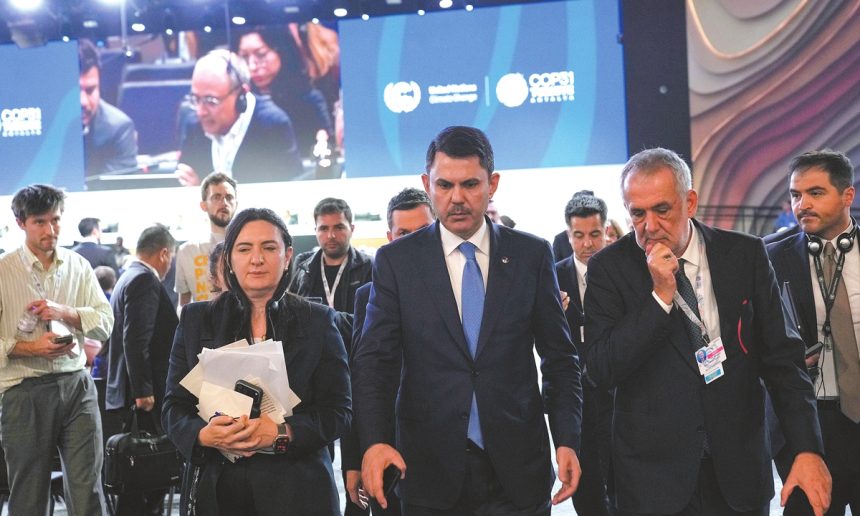
China has expressed profound disappointment following the conclusion of the 31st United Nations Climate Change Conference (COP31) in Turkey without a comprehensive agreement. Despite the setback, Beijing’s representatives urged countries to maintain confidence in multilateralism and enhance international cooperation to address climate change.
The conference, which concluded on Sunday, failed to achieve consensus on the proposed Antalya Pact, highlighting deep divisions among nations regarding the transition away from fossil fuels, climate financing, and the respective responsibilities of developed and developing economies in combating global warming.

China is however clear that the failure to secure an agreement represents a significant setback for international climate diplomacy, especially at a time when accelerated collective action is crucial to limit global temperature increases and support vulnerable populations affected by climate change.
Li Gao, Vice Minister of China’s Ministry of Ecology and Environment and head of the Chinese delegation, said the outcome was disappointing but emphasized that it should not erode confidence in the multilateral climate process.
Li cautioned against mutual recriminations, stating that finger-pointing would diminish trust and hinder countries’ ability to find common ground.
“To address the common challenge of climate change, upholding multilateralism, solidarity, and cooperation is the only way forward,” Li asserted.
China’s Foreign Ministry spokesperson, Guo Jiakun, echoed this sentiment, stressing that there was no turning back from transitioning to green and low-carbon. Guo added that countries must respect multilateral rules, scientific evidence, and their unique national circumstances.
“Let me stress that tackling climate change requires global effort. Green and low-carbon transition is an irreversible trend,” Guo reiterated.
Despite the setback, Beijing reaffirmed its commitment to advancing its national climate strategy, including its targets for peaking carbon emissions and achieving carbon neutrality. Li stated that China would implement the climate objectives outlined in its 15th Five-Year Plan (2026-2030) and its Nationally Determined Contributions, while accelerating the green transformation of its economy and society.
The commitments are supported by China’s increasing investments in renewable energy and its growing role in manufacturing and exporting clean-energy technologies.
An opinion article by Stuart Kirk in the Financial Times highlighted China’s contribution to global decarbonization. Citing figures from the Centre for Research on Energy and Clean Air, the article noted a reported 3.1 percent decline in China’s carbon emissions in the third quarter of 2026.
The article also pointed to China’s rapid expansion of solar and wind power, with its renewable energy investments increasingly surpassing the growth in domestic electricity demand.
Furthermore, China’s clean-energy exports, particularly solar panels, electric vehicles, and batteries, are aiding other countries in reducing their reliance on fossil fuels. Its dominance in rare-earth mining and processing further positions China at the center of global renewable energy supply chains.
During COP31, the Chinese delegation reported active participation in negotiations across all 165 agenda items, holding over 50 ministerial-level bilateral meetings and engaging in more than 10 ministerial-level multilateral consultations in efforts to bridge differences.
However, the failure to reach an agreement has also raised concerns about the efficacy of international climate negotiations in delivering tangible action, especially for developing countries that face escalating climate risks with limited financial resources to respond.
In Africa, the outcome drew strong criticism from negotiators and climate advocacy organizations, who argued that the conference failed to address the continent’s urgent demands for predictable and accessible climate finance.
Antwi Boasiako Amoah, Chair of the African Group of Negotiators, described the outcome as a major disappointment, questioning why parties were not given more time to resolve their differences and reach consensus.
Baboucar Nyar, Coordinator of Climate Action Network Africa, stated that African countries entered the negotiations seeking stronger commitments on adaptation financing, including calls to triple adaptation finance against an agreed baseline.
He emphasized the continent’s need for predictable, grant-based financing to support communities increasingly affected by droughts, floods, and other climate-related disasters.
Nyar argued that the failure to secure meaningful commitments reflected a broader issue where countries prioritized national interests over the needs of vulnerable populations.
The negotiations also exposed tensions over the transition away from fossil fuels. While some countries, including the European Union, opposed the proposed text for its perceived inadequacy in explicitly addressing fossil fuels, African representatives maintained that any transition must acknowledge the continent’s development needs and limited access to electricity.