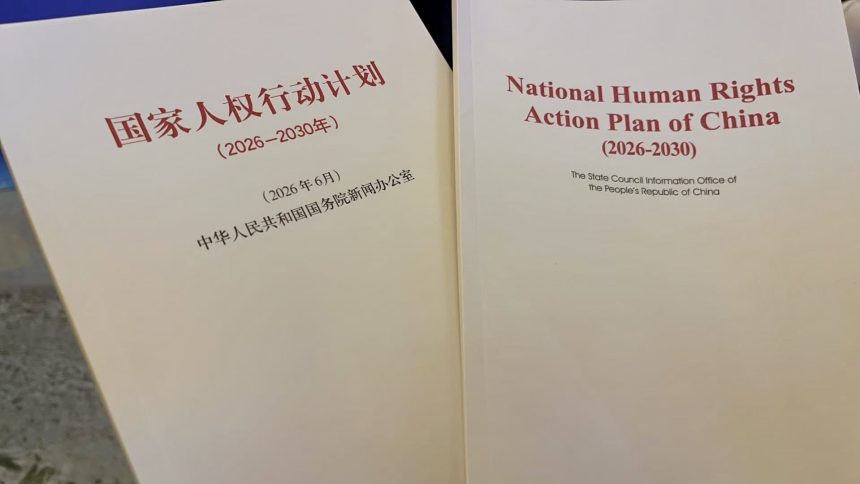
China has released its National Human Rights Action Plan (2026-2030), an ambitious five-year roadmap aimed at strengthening human rights protections, by prioritising economic, social and cultural development as the bedrock for enhancing the wellbeing of its populace.
The State Council Information Office made public the plan on Wednesday, detailing China’s objectives, policy measures and implementation framework for respecting, protecting and promoting human rights between 2026 and 2030.

The action plan comprises eight chapters, encompassing economic, social and cultural rights; civil and political rights; environmental rights; protection of vulnerable groups; emerging human rights; human rights education; and global human rights governance.
A core tenet of the blueprint is the commitment to improving people’s quality of life through high-quality development, expanded access to public services and a more equitable distribution of development benefits.
“The objectives of the Action Plan are respecting the principal position of the people, safeguarding the people’s fundamental interests, promoting social fairness and justice, and ensuring that the gains of modernization benefit all people fairly,” the document states.
The government asserts that this new plan builds upon the achievements of the previous Human Rights Action Plan (2021-2025), which it credits with “remarkable progress in human rights protection” and a contribution to global human rights development.
Acknowledging persistent challenges such as imbalanced development, the government says the new strategy seeks to address emerging demands arising from technological advancements, industrial transformation and shifting societal expectations.
Economic, social and cultural rights are given the most significant emphasis within the plan. In the document, Beijing outlines extensive initiatives designed to improve livelihoods, reduce inequality and broaden access to quality public services.
Among the key priorities is the continued consolidation of poverty alleviation gains through comprehensive rural revitalisation. China says it intends to bolster mechanisms that prevent people from relapsing into poverty, while simultaneously expanding agricultural industries, rural tourism, e-commerce and employment opportunities to increase rural incomes.
The government has also pledged substantial infrastructure investments, including the construction and renovation of approximately 175,000 kilometres of urban water supply pipelines and extending rural tap water coverage to 98 per cent by 2030.
Housing is another critical area, with the government announcing plans to renovate 500,000 dilapidated urban housing units and upgrade 115,000 ageing residential communities. Concurrently, government-subsidised housing for low-income families and young people will be expanded.
The action plan also promises stronger employment protections through an employment-first strategy. This strategy aims to create quality jobs, expand vocational training and reinforce labour rights.
Authorities state they will improve mechanisms for wage growth, combat employment discrimination, protect workers in flexible and digital employment, and ensure the timely payment of salaries, including for migrant workers.
Furthermore, the government has pledged to strengthen China’s social security system by expanding pension coverage, unemployment insurance, work injury insurance and healthcare benefits. This will also involve increased protection for rural residents, migrant workers and those in flexible employment.
Healthcare reforms feature prominently in the new strategy. in the plan China aims to raise average life expectancy to 80 years by 2030, whilst reducing maternal, infant and child mortality rates to levels comparable with high-income countries.
The government also plans to enhance primary healthcare, strengthen disease prevention systems, expand medical insurance coverage and improve access to medicines, particularly in rural and underserved communities.
The document states: “The government will uphold public welfare and equity in the healthcare sector and work to ensure equal access to basic public health services.”
Education reforms are equally ambitious, with Beijing promising greater equality in education by reducing regional disparities, expanding preschool education, improving vocational training and increasing higher education enrolment to 65 per cent.
The government has also reaffirmed its commitment to maintaining public spending on education above four per cent of GDP, while improving financial support for students at every level.
Over and above social development, the plan also seeks to enrich cultural rights by expanding public cultural facilities, preserving cultural heritage, promoting reading and improving access to museums, libraries and cultural institutions.
China has further pledged to strengthen environmental rights by promoting green development, protecting ecological security and ensuring harmonious coexistence between humanity and nature as part of its broader modernisation agenda.
The action plan also outlines measures to better protect the rights of women, children, older persons, ethnic minorities and persons with disabilities, whilst opposing all forms of discrimination.
It further commits to advancing emerging human rights issues associated with digital technology, artificial intelligence and corporate responsibility, by promoting ethical innovation and encouraging businesses to strengthen human rights due diligence.
Internationally, China says it will continue to participate actively in global human rights governance through the United Nations, while promoting dialogue, cooperation and multilateral engagement.
The action plan was compiled under the leadership of the State Council Information Office and the Ministry of Foreign Affairs, before being reviewed and approved through China’s joint national mechanism responsible for implementing the country’s human rights agenda.
According to the government, the blueprint is anchored on China’s constitutional principle of respecting and protecting human rights, whilst drawing upon the Universal Declaration of Human Rights, the Vienna Declaration and Programme of Action and other international human rights conventions.
Officials say implementation of the plan will support China’s broader objective of achieving socialist modernisation, while ensuring citizens experience “a stronger sense of gain, fulfilment, and security in human rights protection.”