For millions of Africans, blurry vision is an unseen barrier one that quietly derails school performance, limits job opportunities, and chips away at confidence and dignity.
Yet for many, the solution is as simple as a basic pair of eyeglasses.

This quiet crisis is now in the spotlight after three Kenyan startups were selected for the world’s first accelerator dedicated entirely to strengthening eye health systems on the continent.
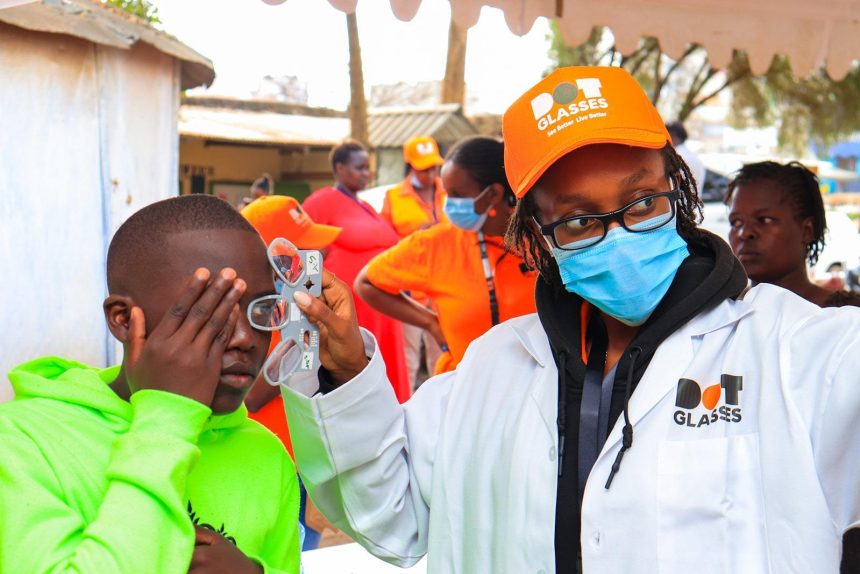
Among them is Dot Glasses, a small team with a big dream: ensuring that no African is held back because they cannot see.
The Africa Eye Health Accelerator launched by Fred Hollows Foundation in partnership with Villgro Africa is bringing together innovators tackling one of Africa’s most overlooked public health and economic challenges.
For Kenya, the selection is also a recognition of its growing role as the continent’s hub for health-tech solutions According to Ross Piper, CEO of Fred Hollows Foundation, the accelerator represents a critical step toward reshaping the future of eye care on the continent.
He notes that traditional systems alone are unlikely to meet growing demand, making innovation essential to expanding reach and improving outcomes.
Research conducted by The International Agency for the Prevention of Blindness, Seva Foundation and The Fred Hollows Foundation shows that investments in eye health deliver at least 28 times the economic return by improving productivity, education outcomes, and overall quality of life.
Across sub-Saharan Africa, at least one billion people globally live with vision impairment that could have been prevented or treated. Without action, the World Health Organization warns that half of the world’s population could be myopic by 2050.
For countless children, this means struggling to see the blackboard. For adults, it means losing income, mobility, and independence. Vision loss is not only a health issue it is a social and economic one.
Such statistics reveal a harsh truth: access to something as simple as a pair of glasses is still out of reach for too many.
For Dot Glasses, the crisis is personal. Their mission began with a simple belief that clear vision should not depend on wealth or geography.
Their business model is built around instant-assembly spectacles that can be adjusted to fit wearers on the spot. No costly machinery.
No long waits no reliance on complicated supply chains that often break down before reaching rural communities.
This model is already restoring confidence and opportunity to thousands who had simply accepted poor vision as fate.
Adam Boxer, the startup’s Co-Founder and Co-CEO, says joining the accelerator is a turning point not only for the organisation but for Africa’s vision agenda as a whole.
The programme gives them access to technical support, market insights, and mentorship from global experts support that could help scale their work to underserved communities across the continent.
The cohort includes two other Kenyan startups: Zuri Health and Mamy Eyewear further cementing Kenya’s position as a leader in homegrown health-tech innovation.
Together, they represent a wave of African entrepreneurs designing practical, scalable, and affordable solutions for real problems on the ground.
Their selection also reflects the strength of Kenya’s startup ecosystem a landscape supported by investors, incubators, and policy frameworks that encourage bold ideas that solve social challenges.
Improving access to eyeglasses restores more than sight it restores livelihoods, learning, and dignity.
Research from leading global eye health organisations shows that every shilling invested in eye health returns up to 28 times its value in improved productivity, education outcomes, and quality of life.
As the accelerator gains momentum, its purpose extends beyond funding. It seeks to reimagine how eye care is delivered: more decentralised, more accessible, and more rooted in local innovation.
Solutions include AI-assisted diagnostic tools, community-based screening, mobile clinics, and locally assembled eyewear innovations designed to reach people where they live, not where systems expect them to travel.
For Kenya and the continent, this is a chance to rewrite the story of eye care and ensure that millions more can access the transformative power of clear vision.