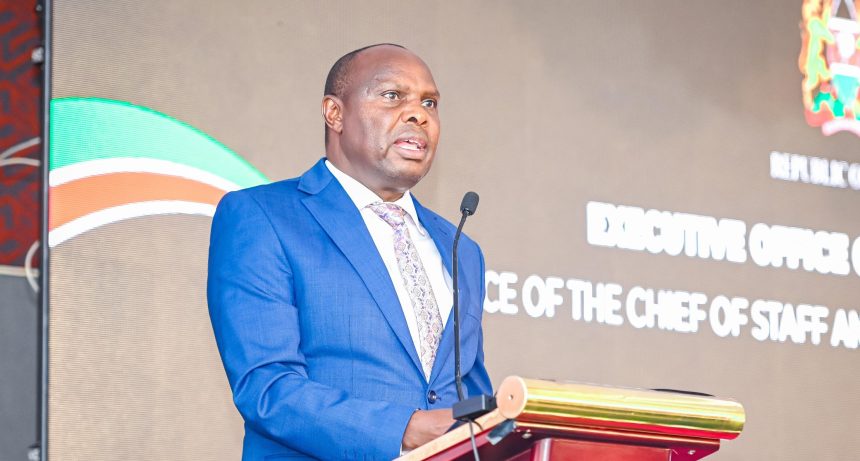
African public service commissions have been urged to boost merit-based recruitment, professional development and performance management to build capable institutions and improve service delivery across the continent.
Chief of Staff and Head of Public Service, Felix Koskei stated that Africa’s development aspirations depended on public institutions’ ability to implement policies, maintain continuity and respond to emerging challenges.

“Africa’s ability to realise its development aspirations depends to a significant degree on the capacity of its public institutions to translate policy into effective implementation, to maintain institutional continuity, to respond to emerging shocks, and to deliver sustainable outcomes to citizens,” he said, in a speech read on his behalf by Secretary to the Cabinet, Mary Wanjau during the opening of the Association of African Public Service Commissions (AAPSCOMS) General Assembly and Conference in Nairobi.
The Head of Public Service further urged the Commissions to uphold competence, merit and fairness in recruitment, promotion and professional development, warning against appointments based on patronage.
“A commission that recruits staff without regard for competence has failed. A commission that promotes individuals on the basis of patronage rather than merit has failed,” he reiterated.
Koskei hence called for stronger performance management, accountability and continuous training to ensure public officers remained competent and responsive to citizens’ needs.
He observed that public service institutions across Africa faced economic uncertainty, technological disruption, climate-related risks and changing workforce demands, requiring institutions to become more resilient and adaptable.
Koskei also urged commissions to strengthen peer learning and collaboration, saying the exchange of experiences and proven practices could improve efficiency, build capacity, and reduce costly experimentation.
He at the same time encouraged delegates to use technology to make public services more transparent, accessible, timely and cost-effective and to turn conference discussions into practical improvements for citizens.
Speaking at the Conference, Prof. Somadoda Fikeni, Vice-President of AAPSCOMS for Southern Africa and Chairperson of South Africa’s Public Service Commission, pointed out that weak institutions could undermine governments’ ability to implement development plans.
“No matter which leader has aspirations, if you can’t implement the policy because the state is weak, the state has no capacity, because public service is weak, then we can’t go too far,” he stated.
Prof. Fikeni reiterated that public administrations faced mounting pressures, including economic uncertainty, climate-related disasters, technological disruption, migration, unemployment and widening inequality.
He therefore called for stronger collaboration among public service commissions and oversight institutions to ensure continuity in service delivery despite political transitions.
Prof. Fikeni also identified peer learning, digital transformation, artificial intelligence, data management, disaster preparedness and anti-corruption as priority areas for capacity building.
To this end, he reiterated that commissions needed to understand emerging technologies to provide effective oversight.
“Because you can’t do oversight over people when they know more than you do,” he advised, calling for continuous training, reskilling, and professional development.
In addition, he mentioned that peer learning would help countries share expertise, adopt proven systems and avoid costly duplication, particularly where resources were limited.
He also called for greater self-reliance in financing reforms as traditional development funding became less predictable.
Professor Tunji Olaopa, Vice-President of AAPSCOMS for West Africa and Chairperson of Nigeria’s Federal Civil Service Commission, urged the Association to expand its membership, strengthen partnerships, and move beyond periodic conferences to sustained engagement and knowledge sharing.
Prof. Olaopa noted that commissions had a responsibility to safeguard merit, develop talent, reward performance, and uphold integrity in public administration.
“Institutions that keep finding and attracting talent, protect merit, build on it, reward good work, and defend integrity in the end will be able to gain the trust of the public,” he averred.
Prof Olaopa observed that African public services continued to face challenges in training, performance management, and attracting and retaining skilled professionals.
He warned that institutions risked losing trained personnel when they failed to offer competitive remuneration and opportunities for professional growth.
Olaopa called for reforms in recruitment, staff development, performance management, leadership training and accountability. He also proposed continuous learning programmes, a digital knowledge library and comparative research to strengthen institutional capacity.
AAPSCOMS President Francis Meja said the conference provided an opportunity to review the Association’s achievements, challenges, sustainability, financing and governance, while considering ways to expand membership and mobilise resources.
The meeting, initially scheduled for Abuja, Nigeria, was moved to Nairobi following a request by Nigeria’s Federal Civil Service Commission and a resolution by AAPSCOMS’ Executive Committee.
At the event, the Association also launched its website, developed by Peak and Dale Group, to improve access to information and engagement with member commissions and stakeholders.
The conference brought together public service commissioners, commission secretaries and public administration practitioners from across Africa to strengthen cooperation and promote professional, accountable, and effective public services.