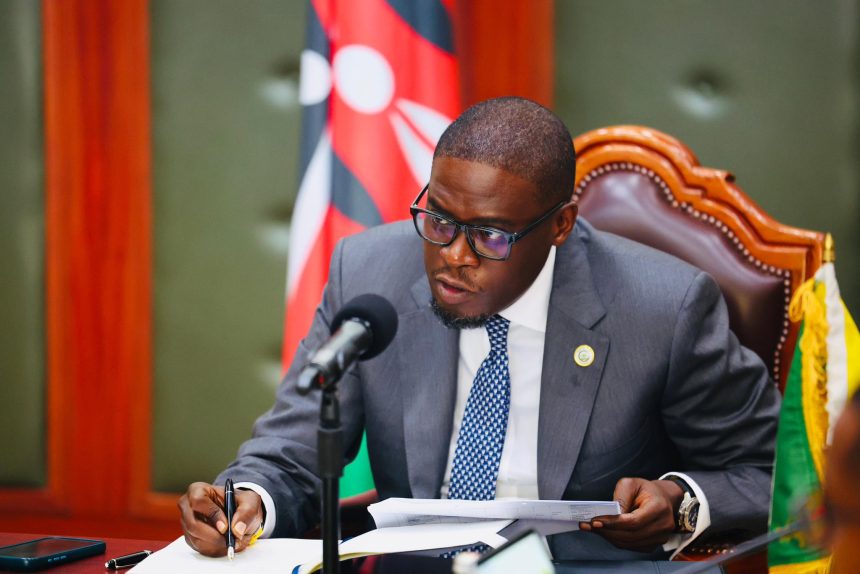
Nairobi Governor John Sakaja has highlighted changes in healthcare delivery in the city, citing improvements in primary healthcare, maternity services, health facility funding and the use of digital systems.
Speaking at the Kenya Health Summit 2026 at the Kenyatta International Convention Centre (KICC) in Nairobi, Sakaja said the city has 7,820 Community Health Promoters (CHPs) covering 780,000 households.

“We have seen a true transformation in the health sector, and I can say it with authority as a governor, in many aspects,” Sakaja said.
He said the changes include the provision of essential services and a reduction in maternal mortality, citing Pumwani Hospital as an example.
“Hospitals like Pumwani, which would be on the news every day for the wrong reason, have now zero percent maternal mortality out of 16,500 deliveries,” he said.
Sakaja said Riruta Hospital is now conducting about 100 deliveries a month, while new maternity services have been introduced in Kayole 2 and Mathare North.
He also highlighted changes in funding for health facilities, saying some facilities that previously received Sh100,000 over two years are now receiving about Sh4 million a month.
“We have facilities that would get 100,000 shillings in two years, in a year getting 4 million shillings a month, allowing them to invest in healthcare and to invest in serving our people,” Sakaja said.
The Governor said the constitutional right to health requires deliberate government action through planning and legislation.
“The right to health will not fulfil itself. It has to be designed. It has to be planned. It has to be thought out. There has to be legislation.”
Sakaja said constitutionalism should be about fulfilling the rights provided for in the Constitution and not simply talking about them.
“Constitutionalism is not just about mandamano or making noise. Constitutionalism is about fulfilling the constitution,” he said.
According to him, access to healthcare should not depend on a person’s ability to pay, noting that families can be forced to sell livestock and investments when a member falls ill.
“This is what Katiba is, giving that right to every Kenyan, that health is no longer a privilege for the few. It is not a privilege for those who have money,” Sakaja said.
He praised President William Ruto for his actions in the health sector, saying the transformation could become one of his lasting legacies.
“What you’re doing, Your Excellency, I believe this will be one of your most enduring legacies, the transformation of healthcare in our country,” he said.
Sakaja also said more than three million people in Nairobi had registered under SHA, with more than one million actively paying every month. He said the digital health dashboard allows him to see how employed and self-employed residents are participating.
He compared the numbers with Estonia, which he described as the most tech-savvy country in the world and a country Kenya uses for benchmarking.
“The people registered in Nairobi under SHA are two times the population of the whole of Estonia, more than 3 million people registered, and more than 1 million actively paying every month,” he said.
Sakaja also praised thousands of Community Health Promoters across the country for taking healthcare services closer to residents, saying the approach has helped reduce the cost of delivering health services.
“Before, we used to tell the people to go to hospital. These days the CHPs, the hospital is going to the people,” he said.
He thanked the Health ministry and the Community Health Promoters for their role in the health sector before inviting the Chairman of the Council of Governors to make his remarks and introduce the governors attending the summit.