Local cement and concrete products manufacturers have urged both the public and private sectors to adopt low-carbon cement use to support sustainable building and construction standards.
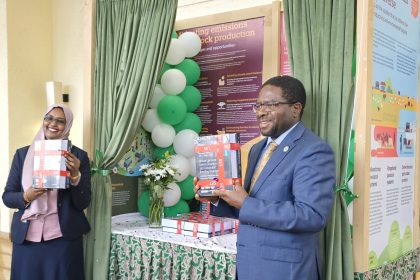
Speaking at a Green Industrialisation and Manufacturing Panel session at the ongoing Kenya Industrialisation Summit 2026, officially opened today by President William Ruto, Bamburi Cement Plc Sustainability and Corporate Affairs Director Eng Jane Wangari said the company has developed low-carbon cement products to advance green and sustainable manufacturing goals.

She said public tender specifications that award higher scores for lower-carbon-emission cements can stimulate wider adoption of locally manufactured low-carbon cement products. She added that including low-carbon cement in the Central Bank of Kenya Green Finance Taxonomy will also help encourage wider adoption and use.
At the Summit organised by the Ministry of Investments, Trade and Industry, Eng Wangari disclosed that Bamburi Cement had formulated, developed and delivered to the market a low-carbon cement product branded as Bamburi DuraCem Cement, an eco-friendly, sulphate and chloride-resistant 42.5 grade cement made in Kenya, for large or marine construction projects.
She confirmed that DuraCem’s manufacturing process, including the use of alternative fuels such as rice husks and waste tyres, delivers a cement product with 64% lower Carbon Dioxide (CO₂) emissions than ordinary Portland cement.
“As cement manufacturers, we are actively playing our net-zero part to facilitate green manufacturing, affirming that it is no longer a pipe dream to deliver products with lower carbon dioxide emissions,” Eng Wangari said.
She added, “We have proved that green manufacturing can be done, as one 50-kg bag of Bamburi DuraCem carries about 64% less carbon dioxide than ordinary Portland cement.That is roughly 25 kg of carbon dioxide saved per bag, about the same as burning 10 litres of petrol.”
By adopting wider use of low-carbon cement products in public and private sector construction, she said the cumulative effect will spur a green industrialisation and manufacturing revolution.
Citing the recent use of DuraCem on Makupa Bridge construction in Mombasa, she said the new bridge now stands proudly as a green infrastructure project, having saved more than 10 million kg of carbon dioxide in the structure, which is also built to resist seawater.
As a sector stakeholder, Bamburi Cement, she said, is actively pushing for the adoption of cement standards and verified Environmental Product Declarations (EPDs) to make “low-carbon” a number anyone can check, like a nutrition label on a packet of unga.
Last month, Bamburi Cement confirmed that it is well positioned to deliver more than 1 million tons of cement for the new Dangote East Africa Petroleum Refinery & Petrochemical SEZ in Lamu County.
As part of its corporate business development plans, the firm is pursuing a commercial opportunity to supply the Dangote East Africa Petroleum Refinery & Petrochemical SEZ with quality cement and concrete products, including low-carbon DuraCem Cement, throughout the project development cycle.
With official assurances that the project will use locally manufactured products, the firm, Ndugwa said, will explore delivering Bamburi DuraCem Cement, an eco-friendly, sulfate- and chloride-resistant 42.5 grade cement made in Kenya, for large or marine construction projects.
Bamburi Cement has supplied cement and concrete solutions for complex national development projects, including Talanta Sports Stadium Development, Rironi Mau Summit Road, Standard Gauge Railway, Dongo Kundu Highway, Mwache Dam, Thwake Dam, and Makupa Bridge, among others.
As a member of the Amsons Group, Bamburi Cement is seeking to secure long-term clinker self-sufficiency, expand production capacity, and support national infrastructure demands.
As part of its corporate business development plans, Bamburi Cement late last year signed a US$250 million (Ksh 32 billion) Engineering, Procurement, and Construction (EPC) contract with Sinoma CBMI Construction Co., Ltd to fbuild a turnkey cclinkerisation factory in Matuga, Kwale County.
The construction of the state-of-the-art 1.6 million tonnes-a-year new clinkerisation plant, incorporating advanced, carbon-neutral technologies to reduce environmental impact, is part of Bamburi Cement’s corporate strategy to double its production capacity for quality cement and concrete products, powering Kenya’s infrastructure development and economic transformation.
Through the turnkey clinkerisation factory, Bamburi Cement Plc aims to more than double its clinker and ultimately its cement production capacities, from 1 million Tons to 2.6 million Tons for Clinker and from 1.8 million Tons to 4 million Tons for quality cement.