
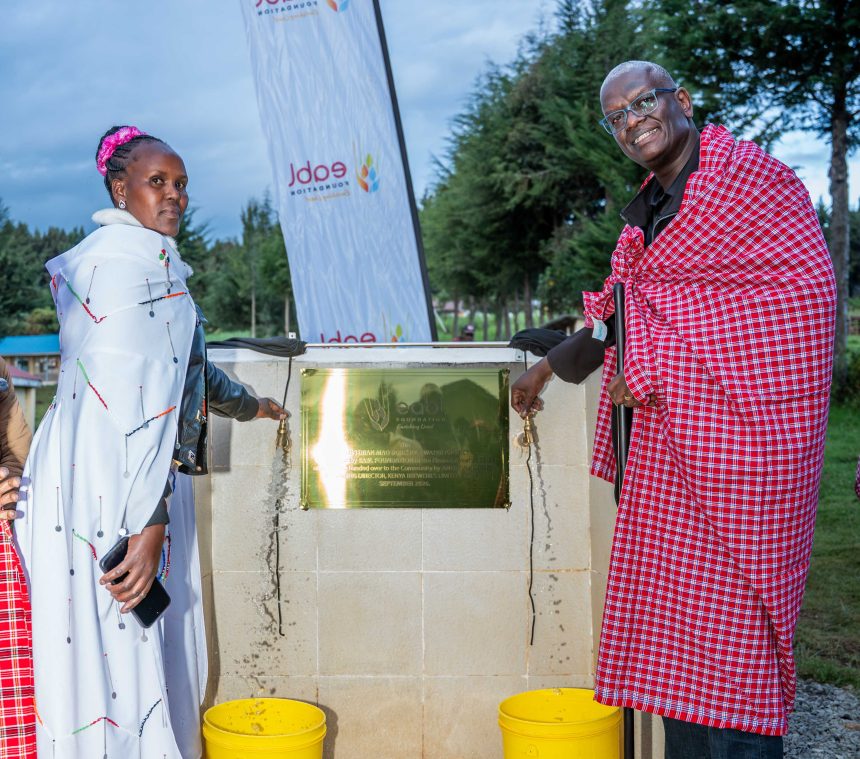
More than 8,000 residents of the Oloserian Mao community in OloKurto, Narok North Constituency, are set to benefit from improved access to clean and safe water following the commissioning of a community water project supported by the KBL Foundation.
The project, implemented in collaboration with Ja Gedo Innovations and Frisco Engineering, responds to longstanding challenges around access to reliable water for households, schools and livelihoods in the area.

The project serves two key points within the community, including Oloserian Mao Secondary School and a community water point serving surrounding households. It comprises a borehole, a 24 cubic metre elevated water tank mounted on a 12-metre water tower, a solar powered water and irrigation system, as well as training for 13 members of the local Water Management Committee.
Speaking during the commissioning ceremony, Kenya Breweries Limited Managing Director Andrew Kilonzo said access to reliable water would help address an important barrier to the community’s social and economic wellbeing.
By commissioning the Oloserian Mao water project, we are helping to close a gap in access to clean and safe water that has affected this community for a long time. Reliable water is essential not only for health and sanitation, but also for education, livelihoods and the ability of communities to realise their full potential.
For residents, the significance of the project extends beyond the availability of water. Community members say they have for years had to travel to distant water sources, purchase water at high prices or rely on sources whose quality was not always assured.
Regina Nkoriompai, a resident of OloKurto, said the new water supply would make a meaningful difference. Regina Nkoriompai, a resident of OloKurto, said the new water supply would make a meaningful difference to families, particularly women and children who have traditionally carried much of the responsibility for fetching water.
We are very happy to have water here. When the water ran out, we had to go to other places to look for it. We spent a lot of time and money getting water, and sometimes the water was not safe for our children. We are very thankful to the people who have brought this water to our community.
The availability of water is also expected to support agricultural activities through the project’s solar powered irrigation component, creating opportunities for households to improve food production and livelihoods.
For the community leadership, the project represents a shift from dependence on external support towards local ownership and responsibility.
The Chairman of the community Water Management Committee, Richard Kishoiyan said the community had sought support from various organisations before KBL responded to its needs.
We used to spend a lot of money buying water, and sometimes the water was not safe. Today, we are privileged to witness EABL Foundation responding to our request. We are receiving water, and water is life. We thank EABL Foundation for responding to our request.
He emphasised that the infrastructure belongs to the community and that residents have a responsibility to protect and sustain it.
This is our project and we have to own it. Sustainability of the project must come from us. We have been trained, and we must make sure that the water resource and the infrastructure are protected for our children and the generations that come after us.
The 13-member Water Management Committee has been trained to support the management and sustainability of the project, including oversight of the water infrastructure and responsible use of the resource.
The project also seeks to strengthen the link between water access and livelihoods by providing irrigation infrastructure alongside domestic and institutional water supply.
For families in OloKurto, the impact is expected to be felt in everyday activities, from household chores and personal hygiene to children’s education and agricultural production.
The EABL Foundation’s investment forms part of its commitment to supporting communities around its areas of engagement through initiatives that contribute to sustainable livelihoods and improved community wellbeing.
With the commissioning of the OloKurto water project, residents now have a community managed water resource designed to serve both present needs and future generations.